Ask Sid about Permutations and Combinations
When the order matters and when it doesn't, why that changes the odds, and a calculator to try it on.

What are permutations & combinations?
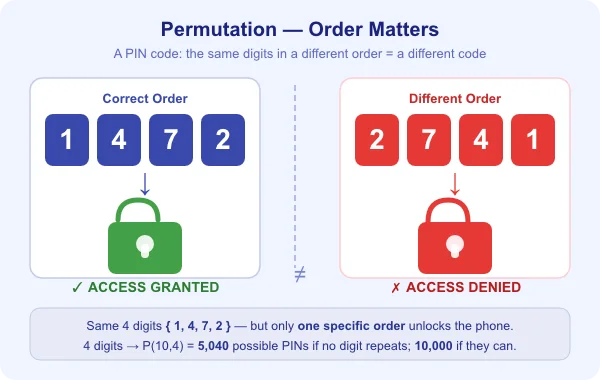
Permutations (order matters)
Definition: A permutation is an arrangement of objects in a specific order. The order matters in permutations.
For example, the "Combination Lock."
- It’s actually named wrong—it should be called a Permutation Lock. If your code is 4-2-1, you can’t enter 1-2-4 and expect it to open. The order is everything.
Combinations (order doesn't matter)
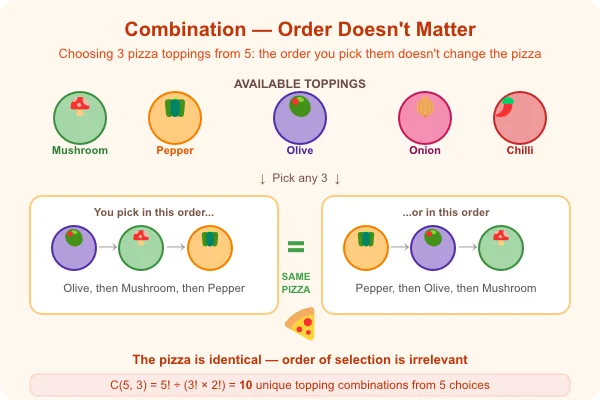
Definition: A combination is a selection of objects where the order does NOT matter. Only the selection itself is important.
For example, choosing 2 letters from A, B, and C:
- AB, AC, and BC are the only combinations
- There are 3 total combinations - note that AB is the same as BA
- Formula: C(3,2) = 3!/(2!×1!) = 6/(2×1) = 3
Try these real-world examples
Click any example to run it in the calculator below.
Quick guide
Use permutations when: order matters (races, passwords, seating arrangements)
Use combinations when: order doesn't matter (lottery, team selection, choosing items)
Live calculator
1Input values
2Results
Enter values and click Calculate to see results
How the numbers grow
Side by side
The formulas
1. Permutations without repetition: P(n,r)
When you select r objects from n total objects, and the order matters:
Example: Choosing 3 people from 5 for 1st, 2nd, 3rd place: P(5,3) = 5!/(5-3)! = 120/2 = 60 ways
2. Combinations: C(n,r)
When you select r objects from n total objects, and the order does NOT matter:
Example: UK Lottery - choosing 6 numbers from 59: C(59,6) = 59!/(6!×53!) = 45,057,474 combinations
3. Permutations with repetition
When you can select the same item multiple times:
Example: A 4-digit PIN with digits 0-9: 104 = 10,000 possibilities
4. Factorial: n!
The number of ways to arrange all n objects:
Important notes
Key differences
- Permutations vs Combinations: Permutations care about order (ABC ≠ BAC), combinations don't (ABC = BAC = CBA)
- With vs Without Repetition: With repetition allows reusing items (only for permutations), without repetition doesn't
- Relationship: For the same n and r, permutations ≥ combinations. P(n,r) = C(n,r) × r!
- Factorial Growth: Factorials grow extremely fast! 10! = 3,628,800 and 20! = 2.4 × 10¹⁸
When to use which?
Use permutations when:
- The order of selection matters
- Examples: Race positions, passwords, seating arrangements, phone numbers
Use combinations when:
- The order of selection does NOT matter
- Examples: Lottery tickets, team selection, choosing toppings, committee formation
Limitations
- Maximum n value is 170 as computers don't want to cope with more than that. The numbers just get silly.
- Results larger than 10308 will display as "Infinity"
- For very large calculations, consider using specialized mathematical software
- Combinations with repetition are not included in this calculator (less common in practice)